
You just laid down gorgeous carpet—and got a head-rush of “new” that won’t quit. Let’s turn that showroom scent into clean, easy-to-breathe indoor air—fast.
Americans spend about 90% of their time indoors, and indoor pollutant levels can be 2–5× higher than outdoors, according to the [U.S. EPA]. That’s why a smart, safety-first plan to remove new carpet odor matters—for comfort today and your air quality long-term.
New carpet odor comes from volatile organic compounds (VOCs) and additives released by the carpet, padding, and adhesives during curing. The good news: with correct ventilation, filtration, and housekeeping, that “new” smell usually drops dramatically within days and fades to undetectable levels in a few weeks. Below is a complete, expert-level playbook—starting with the direct answer you wanted.

New carpet smell is best eliminated by combining aggressive fresh-air exchange, targeted filtration, temperature-and-humidity control, and routine surface maintenance. Open opposing windows and run fans to create cross-ventilation for several hours a day, use an HVAC system or portable purifier with activated carbon to capture gases, keep indoor relative humidity ~40–50%, and vacuum with a sealed-HEPA machine daily for the first week. Avoid masking sprays; instead, remove the source gases and residues. For most homes, this approach takes the odor from “noticeable” to “barely there” within 48–72 hours, and to “gone” in 1–3 weeks.
Speaking with the carpet cleaning experts at DYW Carpet Cleaning in Phoenix, they mentioned, “Odor isn’t just air—it settles on fibers and hard surfaces. The fastest wins come from moving fresh air through the room and combining it with carbon filtration, then doing light, frequent HEPA vacuuming to pick up residue the air carries back down,” says a lead technician we connected with after a regional IAQ clinic sparked a discussion on carpet off-gassing.
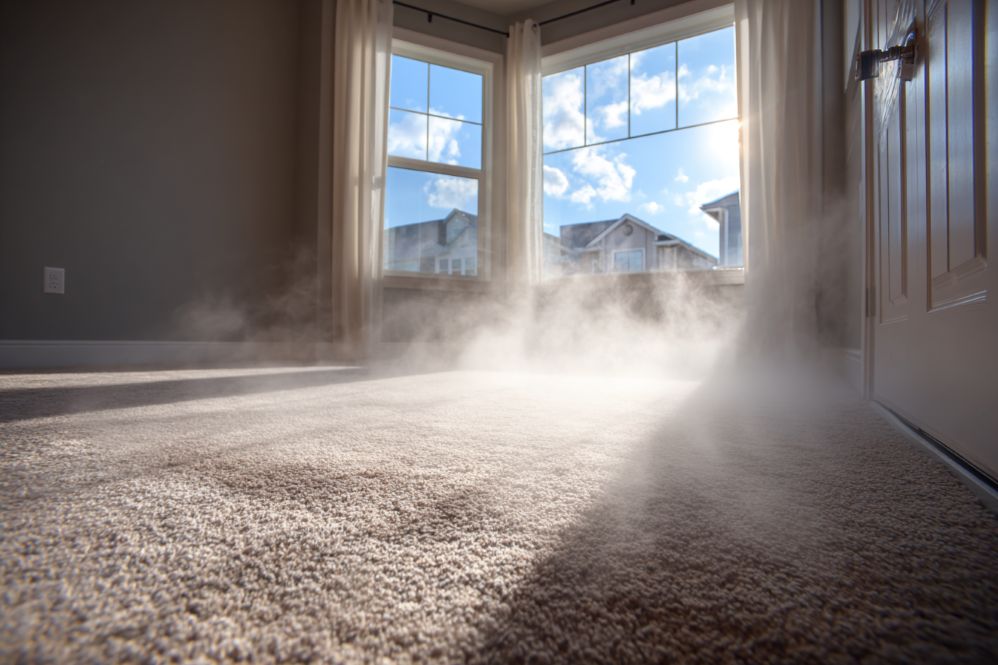
New carpet odor originates from a mix of VOCs emitted by carpet face fibers, backing, padding, and adhesives. While modern carpets are engineered to be low-emitting, you’ll still notice a temporary “factory” scent—especially in warm, poorly ventilated spaces. The good news: carpet-related VOCs typically dissipate within 24–72 hours if ventilation is adequate.
Expert quote — Oak and Steel Remodeling Indoor Air Specialist: “A persistent new-carpet odor almost always points to restricted airflow. Open windows, run fans on exhaust mode, and keep the HVAC fan running continuously for the first 72 hours. If the smell remains strong after five days, request the carpet’s VOC test data from your retailer.”
Most new carpet odors resolve quickly. However, a few warning signs indicate a deeper problem worth investigating:
If any of these apply, contact your installer and request the carpet’s third-party VOC certifications. In rare cases, replacement may be warranted.
Award-winning home remodeling for Phoenix homeowners. Kitchens, bathrooms, whole-home renovations, and more. Serving the Valley for over 25 years.
Marketing by Soderman SEO Company in Phoenix
Phone
(602) 502-1285Service Area
Phoenix Metro Area, AZ
Hours
Mon-Fri 8am-6pm · Sat 9am-2pm
© 2026 Oak and Steel Remodeling. All rights reserved.